RARE EARTHS
Rare Earth oxides (clockwise from top center): praseodymium, cerium, lanthanum, neodymium, samarium, and gadolinium. Rare Earth Elements make up key components of cellphones, televisions, weapons systems, wind turbines, MRI machines and the regenerative brakes in hybrid cars. (AP Photo/U.S. Department of Agriculture, Peggy Greb)
ABOUT WYOMING RARE EARTHS
Northeast Wyoming is home to one of the highest grade rare earths deposits in North America, currently under development.
Rare earth elements (REE) are naturally occurring materials with unique properties that make them essential to new technologies. REEs include 17 elements that share similar chemical properties, which give them the ability to discharge and accept electrons, making them an integral component of many modern day electronic, optical, magnetic, and catalytic uses.
These elements include: Scandium, Yttrium, Lanathanum, Cerium, Praseodymium, Neodymium, Promethium, Samarium, Europium, Gadolinium, Terbium, Holmium, Dysprosium, Erbium, Thulium, Ytterbium, Lutetium.
Rare earth elements work best when they are added in small doses to composites and alloys. They have unique chemical and physical properties that allow them to interact with other elements and get results that neither element could get on its own.
Despite their name, REEs are actually commonly found on the Earth, but most do not occur in large enough quantities and high enough concentrations to mine easily.
What ARE RARE EARTHS?
Origins
Rare earth elements were discovered in 1787 by Swedish Army Lieutenant Carl Axel. They were first commercially produced in the 1880s when they were mined in Sweden and Norway. The first foreign production was in Brazil in 1887, and India began producing them in 1911.
From 1940 to 1990, the United States produced and mined its own rare earth minerals. Mountain Pass mine in California was the biggest resource in the country.
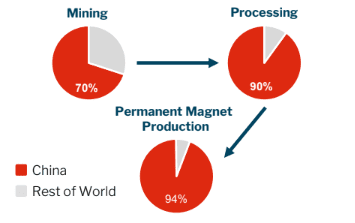
Until the 1980s the U.S. was one of the world’s largest producers. China has increased production by more than 500% since 1990 due to its substantial deposits and cheap labor.
Processing
Rare earths are difficult to mine because they aren’t found in large quantities or veins like other minerals such as gold. They need to be separated from one another using a variety of mining and processing techniques.
There are three main methods for separating and refining the elements including: Fractional Crystallization, Ion-Exchange, Liquid-Liquid Extraction, or Solvent Extraction.
Most REE mines only produce these types of elements using large-scale techniques that involve drilling, blasting, and hauling.
The elements are separated and purified and then refined to meet industry standards for the proper applications.
Uses
These 17 elements are important to the manufacture of many high tech products. In fact, many of the things you use everyday would not exist without REEs.
Neodymium is used to make powerful magnets used in loud speakers and hard drives as well as hybrid cars.
Lanthanum is used in camera and telescopic lenses, as well as studio lighting and cinema projection
Cerium is used in catalytic converters in cars, as well as refining crude oil.
Praseodymium is used to create strong metals for use in aircraft engines. It is also used to make visors to protect welders and glassmakers.
Gadolinium is used in X-ray and MRI scanning systems, as well as television screens.
Yttrium, terbium, and europium are important for television and computer screens, as well as other devices with visual displays.

RARE EARTH By the Numbers
17
Rare Earth Elements
Wyoming
Has the potential to become a major hub for the us rare earths industry
Rare element resources (Rer)
has invested over $170 million in developing its rare earth operations in Wyoming.
Rare earths
are typically found together in mineral deposits



WYOMING MINING - Linked Together - Linked to America
1401 Airport Parkway Suite 230
Cheyenne, WY 82001
